Posts

Showing posts from August, 2022

All About Mandatory GST E-Invoicing in India from 1 October for Businesses

Image
  In an effort to further plug income leaks and ensure improved tax compliance from corporations, the Central Board of Direct taxes (CBDT) has made E-Invoicing in India compulsory for businesses with annual revenues surpassing Rs 10 crore from October 1 . According to the centre, the norm regarding council suggestions has been changed. Currently, companies having yearly revenue of more than Rs 20 crore are required to use GST e-invoices.   Beginning on October 1, 2020 , businesses with a turnover of more than Rs 500 crore were included in the scope of e-invoicing in India for business-to-business (B2B) transactions. Businesses in the second phase were required to start issuing e-invoices from January 1, 2021 , if their annual revenue exceeded Rs 100 crore . From April 1, 2021 , businesses having a turnover of more than Rs 50 crore were required to generate e-invoices. With effect from April 1, 2022 , enterprises with annual revenues above Rs. 20 crore are u...
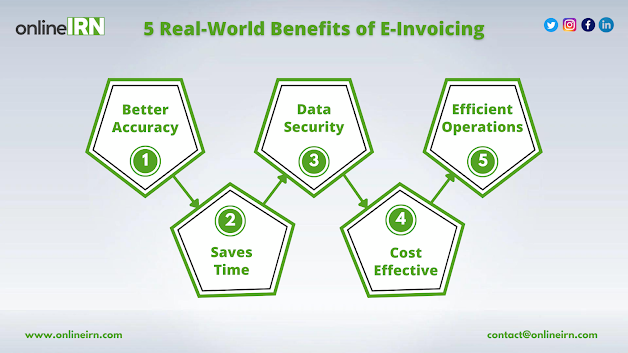
5 Real-World Benefits of E-Invoicing in India for Businesses | Online IRN

Image
  B2B invoices are digitally submitted to a system where they are verified by the GSTN (Goods and Services Tax Network) using a procedure known as electronic invoicing, or E-Invoicing in India . The goal of the implementation of e-invoicing is to ensure that all Indian businesses across various industries utilize a standard format, making compatibility easier. An IRN or Invoice Reference Number is generated for each and every e-invoice that is generated.   First, starting on October 1, 2020, companies having a revenue of at least 500 crores rupees were required to use invoices. Second, starting on the first of January 2021, e-invoicing in India was made available to companies having a revenue of at least 100 crores rupees. E-invoicing in India was made available to companies having a revenue of at least rupees 50 crores started on April 1st 2021, as part of the third phase. As of 1 April 2022, it is applicable to ...